Advertising has always been about psychology. It’s about understanding what makes people tick — their fears, desires, aspirations, insecurities — and using that knowledge to make them care about a product.
But here’s what’s changed: AI has supercharged this entire process.
What used to take weeks of testing and guesswork now happens in minutes. AI tools analyze millions of data points to figure out which emotional triggers work, which images convert, and which words make people click “Buy Now.“
If you’ve ever used creative tools like an Ambigram Generator or experimented with narrative tools such as an AI Story Generator you’ve already seen a small glimpse of how AI learns what resonates emotionally.
But what’s actually going on behind the scenes? And how exactly does psychology shape the ads you see every day?
Let’s break it down.
What Is the Psychology of Advertising?
The psychology of advertising is the study of how people respond to ads — and how advertisers use psychological tactics to influence buying decisions.
This isn’t new. Advertisers have been studying human behavior for over a century.
Early pioneers like Walter Dill Scott, John B. Watson, and Claude Hopkins developed techniques that are still used today.
They figured out something fundamental: people don’t make decisions based on logic. They make decisions based on emotion.
That’s the foundation of all advertising psychology.
You don’t buy a luxury car because it has a 0-60 time of 4.2 seconds. You buy it because it makes you feel successful, powerful, or free.
You don’t buy skincare because the formula contains hyaluronic acid. You buy it because you want to look younger, feel more confident, or solve a problem that’s been bothering you.
Advertisers tap into those emotions. They create a connection between the product and the feeling you want. And if they do it right, you buy.
The Core Principle: Emotion Beats Logic Every Time
Here’s the uncomfortable truth: most buying decisions are emotional, not rational.
You justify them with logic later. But in the moment? You’re driven by feelings.
Advertisers know this. So they don’t lead with features. They lead with emotions.
Examples:
- A luxury watch brand doesn’t talk about the Swiss movement. They show you a successful executive closing a deal, glancing at his wrist, exuding confidence.
- A fitness app doesn’t talk about the algorithm. They show you someone celebrating weight loss, feeling proud and accomplished.
- A travel company doesn’t list amenities. They show you a couple on a beach at sunset, feeling free and in love.
The product is secondary. The emotion is the sell.
And the better an advertiser understands which emotions drive their audience, the more effective their ads become.
Common Psychological Tactics in Advertising
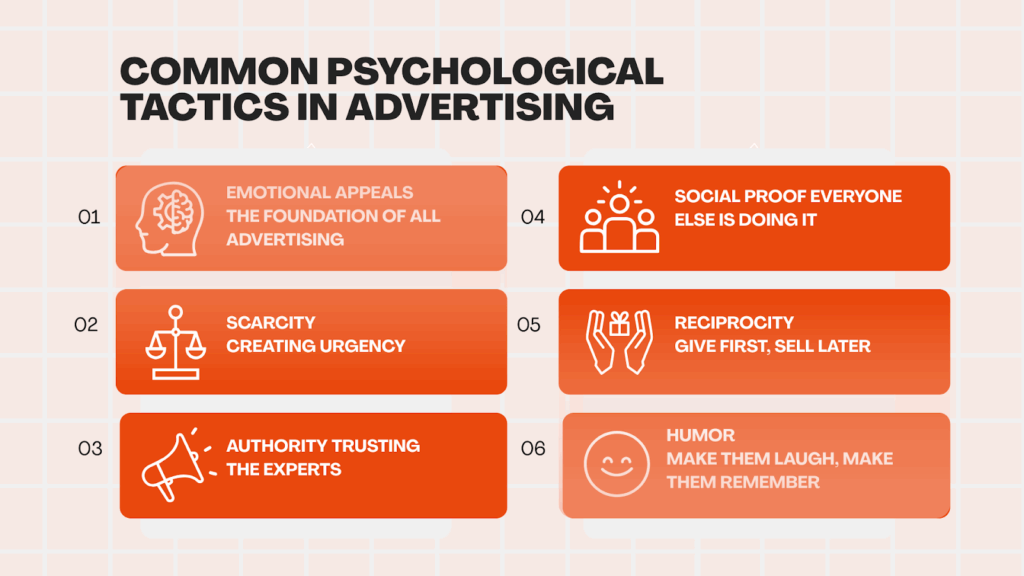
Let’s break down the most common tactics advertisers use to influence behavior.
1. Emotional Appeals (The Foundation of All Advertising)
Emotional appeals tap into what people want, fear, or desire.
Common emotions used in ads:
- Fear — “Protect your family with home security” or “Don’t let your competitors get ahead”
- Desire — Luxury, status, success, beauty, freedom
- Nostalgia — “Remember the good old days?” (often used in food and beverage ads)
- Happiness — “This product will make you feel good”
- Belonging — “Join the community” or “Be part of something bigger”
Example:
A luxury car brand shows a couple driving through scenic mountains with the sun setting behind them. The ad doesn’t talk about horsepower or fuel efficiency. It talks about freedom, adventure, and the lifestyle that comes with owning that car.
The message: Buy this car, and you’ll feel like this.
2. Scarcity (Creating Urgency)
Scarcity makes people feel like they need to act fast before they lose out.
Common scarcity tactics:
- Limited-time offers — “Sale ends tonight at midnight”
- Limited quantities — “Only 3 left in stock”
- Exclusive access — “Available only to our VIP members”
Example:
A travel company offers a discount on a vacation package with the message: “Book in the next 24 hours and save $500.”
This creates urgency. You’re not thinking about whether you actually need the vacation. You’re thinking about whether you can afford to miss the deal.
Scarcity works because people fear loss more than they desire gain. Missing out feels worse than not getting something in the first place.
3. Authority (Trusting the Experts)
People trust authority figures. If an expert recommends something, it must be good.
Common authority tactics:
- Expert endorsements — Doctors, scientists, industry leaders
- Celebrity endorsements — Actors, athletes, influencers
- Certifications and awards — “Recommended by dermatologists” or “Award-winning product”
Example:
A skincare brand uses a celebrity spokesperson to promote their products. The message: If this product is good enough for them, it’s good enough for you.
Even outside advertising, brands can enhance credibility using content tools like a Bio Generator to craft professional narratives that build trust.
Authority works because it removes doubt. You don’t have to research the product yourself — someone you trust already did.
4. Social Proof (Everyone Else Is Doing It)
People look to others to decide what’s normal, safe, or desirable.
Common social proof tactics:
- Customer reviews — “5,000+ 5-star reviews”
- User-generated content — Real customers using the product
- Testimonials — “This changed my life”
- Popularity stats — “Join 10 million users”
Example:
A software company shows testimonials from well-known companies using their product. The message: If Google and Amazon use it, it must be good.
Social proof works because humans are tribal.
And even identity-based content — like custom letter designs made using a Name Tracing Generator — taps into belonging and relatability.
We want to do what others are doing — especially if those others are successful, attractive, or similar to us.
5. Reciprocity (Give First, Sell Later)
When someone gives you something for free, you feel obligated to give something back.
Common reciprocity tactics:
- Free trials — “Try it free for 30 days”
- Free samples — Costco built a business model around this
- Free content — Ebooks, guides, webinars, templates
Example:
A SaaS company offers a free 14-day trial. You use it, you like it, and when the trial ends, you feel like you owe them. So you subscribe.
Reciprocity works because humans are wired to return favors. It’s a social norm that goes back thousands of years.
Free trials, free samples, free content — it all works because we’re wired to reciprocate.
6. Humor (Make Them Laugh, Make Them Remember)
Funny ads stick in your brain longer than boring ones.
Example:
A fast-food chain creates a hilarious ad about how eating their burger will instantly improve your mood. You laugh, you remember the brand, and the next time you’re hungry, you think of them.
Humor works because it creates positive associations. When you laugh at an ad, you associate that positive feeling with the brand.
7. The Bandwagon Effect (Don’t Get Left Behind)
This is similar to social proof but with a twist: it’s not just about what others are doing — it’s about the fear of being left out.
Common bandwagon tactics:
- “Join the movement”
- “Don’t be the last one without this”
- “Everyone’s switching to [product]”
Example:
A tech company launches a new product and positions it as the future. The message: If you don’t adopt this now, you’ll be left behind.
The bandwagon effect works because people fear missing out on trends, opportunities, or social acceptance.
The Early Days: How Advertising Psychology Started
Advertising psychology didn’t emerge from nowhere. It has a history.
Walter Dill Scott wrote “The Psychology of Advertising” in 1903. He believed that advertising could tap into people’s desires and needs — and he developed techniques to help advertisers do exactly that.
John B. Watson believed that human behavior was shaped by environment and experiences. He developed methods to create emotional connections between consumers and products.
Claude Hopkins took a different approach. He believed advertising should be based on facts and logical arguments, not just emotional appeals. He pioneered data-driven advertising — testing ads, measuring results, and optimizing based on performance.
These principles? They’re still used today. And now, AI is learning from them and scaling them to a level humans never could.
How AI Studies the Psychology of Advertising
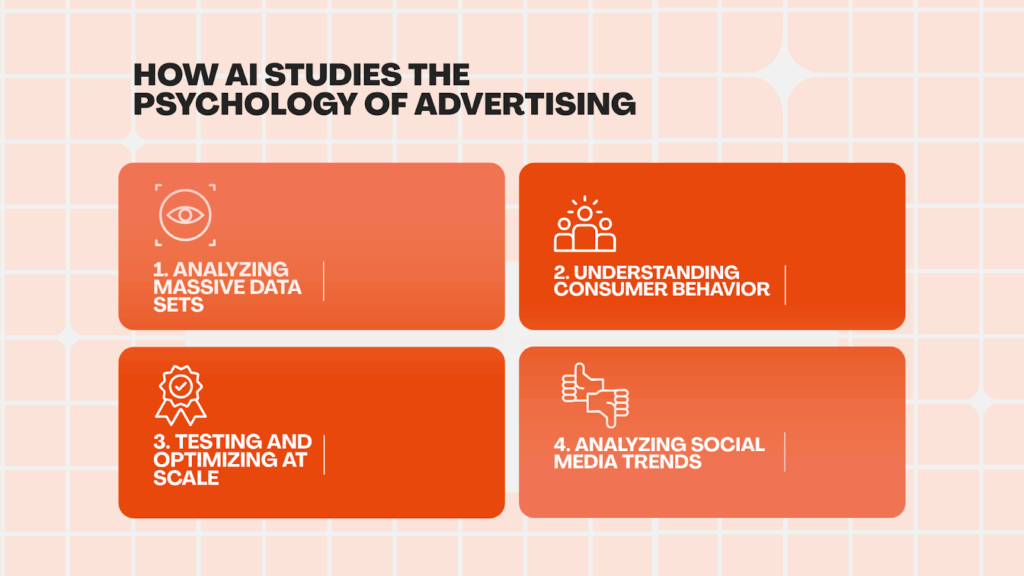
AI doesn’t just create ads. It studies what works and why.
Here’s how:
1. Analyzing Massive Data Sets
AI tools analyze millions of ads to identify patterns:
- Which headlines get the most clicks?
- Which images drive the most conversions?
- Which emotions generate the most engagement?
- Which words trigger buying behavior?
Humans can’t process this much data. AI can.
2. Understanding Consumer Behavior
AI analyzes:
- Browsing history
- Purchase behavior
- Social media activity
- Demographic data
- Engagement patterns
It learns what makes different audiences tick — and uses that knowledge to predict what they’ll respond to.
3. Testing and Optimizing at Scale
AI can generate hundreds of ad variations and test them simultaneously. It learns which versions perform best and optimizes campaigns in real time.
What used to take weeks now happens in hours.
4. Analyzing Social Media Trends
AI monitors social platforms to identify:
- Which influencers people trust
- Which products people are talking about
- Which emotions are driving conversations
- Which trends are gaining momentum
This gives advertisers real-time insights into consumer psychology.
How AI Is Changing the Psychology of Advertising
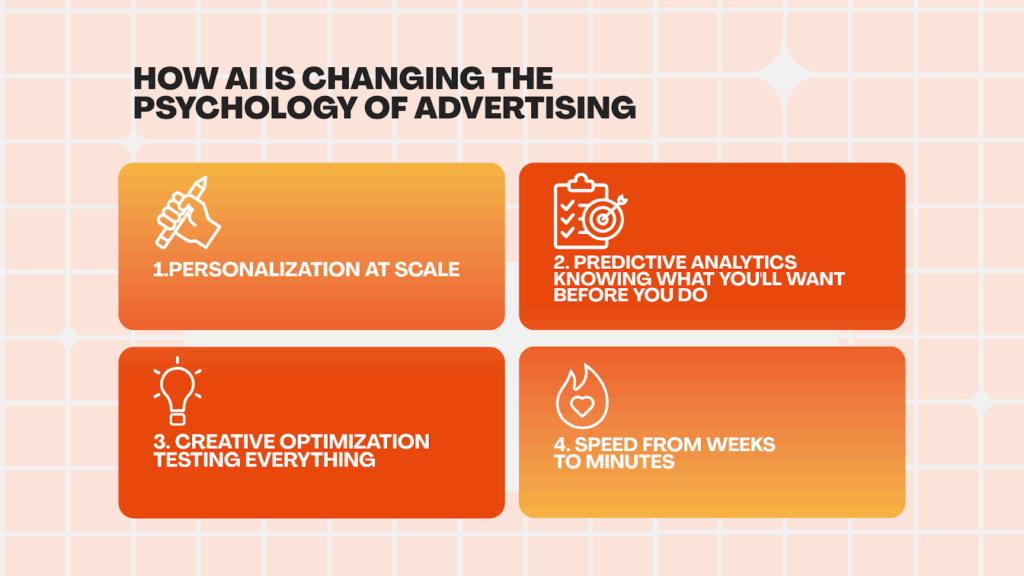
AI isn’t just studying psychology. It’s transforming how advertisers use it.
1. Personalization at Scale
AI creates personalized ads for individual users based on their:
- Browsing history
- Location
- Social media activity
- Past purchases
- Interests and behaviors
The result? Ads that feel like they were made specifically for you. Because they were.
2. Predictive Analytics (Knowing What You’ll Want Before You Do)
AI predicts consumer behavior based on historical data and trends.
It can forecast:
- Which products you’re likely to buy next
- When you’re most likely to make a purchase
- Which psychological tactics will work on you
- Which emotions will drive your decision
This allows advertisers to target you at exactly the right moment with exactly the right message.
3. Creative Optimization (Testing Everything)
AI generates multiple ad variations and tests them against each other:
- Different headlines
- Different images
- Different emotional appeals
- Different calls to action
It identifies what works and optimizes campaigns automatically.
4. Speed (From Weeks to Minutes)
What used to take a creative team days or weeks now takes minutes.
AI can generate ad copy, select images, test variations, and optimize campaigns faster than any human team ever could.
This speed lets advertisers respond to market changes, trends, and consumer behavior in real time.
The Future: How AI Will Influence Advertising Psychology
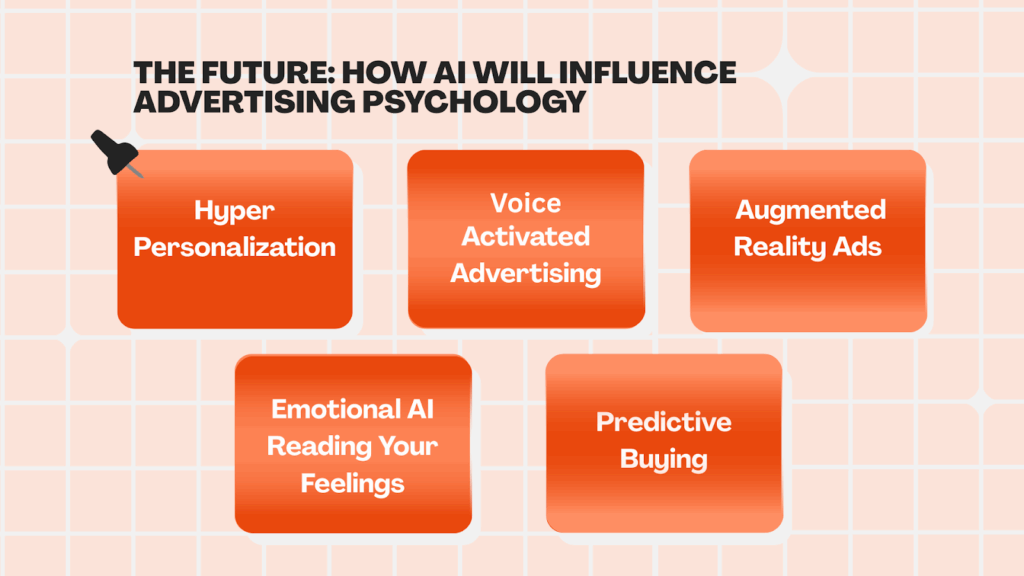
AI is just getting started. Here’s where it’s headed.
1. Hyper-Personalization
Ads will be tailored to individual users at a level we’ve never seen before.
Every headline, image, and message will be customized based on your:
- Personality type
- Current mood
- Recent behavior
- Life stage
- Preferences and values
The result? Ads that feel less like ads and more like helpful recommendations from a friend.
2. Voice-Activated Advertising
With the rise of smart speakers and voice assistants, voice ads will become a major channel.
AI will create personalized voice ads that feel natural and non-intrusive — delivered at exactly the right moment.
3. Augmented Reality Ads
AR will let advertisers create immersive experiences that engage your senses and emotions.
AI will analyze your behavior and preferences to create AR experiences tailored specifically to you.
Example:
You point your phone at your living room, and an AR ad shows you how a new couch would look in your space — customized to your style preferences based on your past behavior.
4. Emotional AI (Reading Your Feelings)
Future AI tools will analyze facial expressions, voice tone, and biometric data to understand your emotional state in real time.
Ads will adapt based on how you’re feeling — showing you different messages depending on whether you’re stressed, happy, bored, or excited.
Creepy? Maybe. Effective? Absolutely.
5. Predictive Buying (AI Knows What You Want Before You Do)
AI will predict what you’ll want to buy before you even realize you want it — based on patterns in your behavior, life events, and preferences.
You won’t search for products. They’ll find you.
The Ethical Question: Is This Manipulation?
Here’s the uncomfortable part: not all psychological tactics in advertising are ethical.
Some ads manipulate. Some deceive. Some prey on insecurities, fears, or vulnerabilities.
As consumers, we need to be aware of these tactics so we can make informed decisions.
As advertisers, we need to ask: Just because we can influence behavior, does that mean we should?
AI makes it easier than ever to manipulate people at scale. But that doesn’t make it right.
The best advertisers use psychology to create genuine value — solving real problems, building trust, and delivering on promises.
The worst ones exploit psychology to trick people into buying things they don’t need or can’t afford.
Know the difference.
Final Thoughts
The psychology of advertising is a fascinating field with a long history and an even more interesting future.
By understanding how advertisers use psychology to influence behavior, you can:
- Recognize when you’re being influenced
- Make better buying decisions
- Create more effective marketing (if you’re on that side of the equation)
AI has taken advertising psychology to a new level. It’s faster, smarter, and more personalized than ever before.
But at its core, it’s still about understanding human behavior — what makes people tick, what they desire, and what drives them to take action.
That hasn’t changed. It never will.

Zawwad Ul Sami is an indie SaaS founder and growth strategist, best known for building and scaling lean, profitable micro-SaaS products. He currently leads Bizreply, an AI platform that helps brands find high-intent social conversations and craft smarter replies at scale.
With multiple micro-SaaS exits and a portfolio that includes tools like Mailtoon, Tweetsy, MySaaSBoilerplate, and Convert My Bank Statement, Zawwad has earned a reputation for fast execution and practical growth tactics. He actively shares insights on product building, social growth, and the micro-SaaS ecosystem, inspiring makers who want to launch and iterate quickly.
Leave a Reply